Why Private APNs Fall Short for Global Industrial IoT
A private APN keeps industrial IoT traffic off the public internet. It does not show what your devices talk to. Here is what closes that gap.
Most OT and IoT security plans start from the network the site already has. An Ethernet segment in a cabinet. Wi-Fi across the factory floor. A VPN back to the control room. Each of those puts every device in the same room as every other device, and the security work then goes into building walls inside that room.
Cellular starts from the opposite end. Each device gets its own connection. Nothing talks to anything else until the network allows it. That changes where your security effort goes.
On a wired segment or a Wi-Fi network, devices share a broadcast domain. A compromised sensor reaches the controller next to it. Segmentation fixes this, but you add it after the fact, with VLANs, access lists and firewalls, and every rule is one more thing to keep right.
Most networks never finish that job. Palo Alto Networks' 2025 Device Security Threat Report found poor segmentation in more than three in four of the enterprise networks it analysed, with IT and IoT devices mixed on the same subnets.
The usual tools carry their own risks. Trevor Dearing, who runs the Industry Solutions team at Illumio, pointed out in a recent IXT webinar that VLANs only count as security when dynamic VLAN protocols are switched off. Isolating a suspect device with network access control has taken down large parts of a network.
A cellular connection runs from one endpoint to the core network. There is no shared segment where devices see each other by default. Henning Solberg, CTO at IXT, put it this way: cellular "gives that endpoint protection from the ground up."
That matters most for the devices that cannot protect themselves. A small microcontroller in an unattended cabinet has no room for an agent, a VPN client or a host firewall. If the device cannot defend itself, the network has to, and cellular gives the network one connection per device to work with before any policy is written.
Trevor sees the same shift on site visits. Factories and energy installations are moving to 5G for two reasons. The connection is reliable in a way Wi-Fi is not, because it is connection-oriented. And the sites are easier to secure.
When refrigeration controllers in stores across Europe were tampered with in autumn 2026, some reports pointed at the 4G box in each store. Henning Solberg disagrees:
"4G in itself is obviously just a carrier here. If you put a device on the open internet, whether it's a wired connection, a Wi-Fi connection, a satellite connection, whatever, if you put a public IP on it with no protection, it will be harmed by somebody, no matter what."
The radio does not decide the risk. The address does, and so does who is able to reach the device. Cellular gives you the point-to-point head start described above. A public IP with no protection throws it away. Henning explains this from 2:28 in his interview on the freezer attacks.
Cellular is a foundation, not a finished design. Two gaps remain.
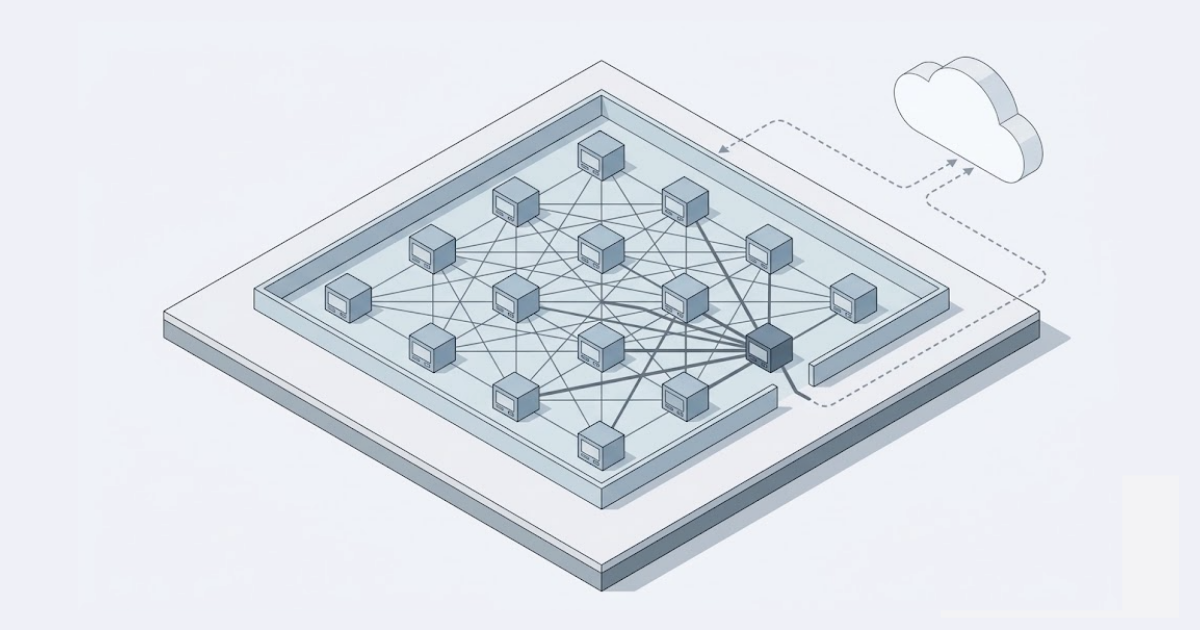
The first is the private APN. It keeps traffic off the public internet, and operators used to treat it as the security boundary. It does not tell you what your devices talk to, and it does not stop one compromised device reaching the rest of the fleet. We cover this gap in the hidden risks of traditional APN connectivity.
The second is the router at the edge. Put a 4G or 5G CPE router at a remote site, connect several devices to it over Ethernet, and you have rebuilt a shared segment at the far end of the cellular link. That segment needs micro-segmentation of its own.
Cellular is not the right link for every device. Inside a building with poor signal, such as a basement plant room, a wired connection is more reliable. A site that already has fibre and a well-segmented OT network gains little from moving to cellular. And a cabinet with dozens of devices in one place is better served by one router with proper segmentation behind it than by a SIM in every device.
The case for cellular is strongest where devices are spread out, unattended, hard to reach with cable, or owned by several parties who should never share a network.
Once each device has its own connection, the work is deciding what each one is allowed to reach. IXT does that in the network. The IXT SIM identifies the device. SecureNet keeps its traffic on a private APN. Zscaler ZTNA in IXT's core network checks every session before a connection opens. Illumio shows every connection in real time and applies policy-based segmentation, including behind a CPE router.
Trevor's view of the combination: "This solution does simplify things a lot, especially at the headless end for those devices."
If you are weighing cellular against Ethernet or Wi-Fi for an OT or IoT site, start here. Do the devices run security software, or does the network have to carry it? Do you know every destination each device talks to today? Will third parties need remote access, and how do they get it now? Are several devices sitting behind one router at remote sites?
The more of these point to the network doing the work, the stronger the case for cellular. For the wider architecture, read what network-level Zero Trust for IoT devices means, or the eight lessons from our webinar with Illumio.
Henning and Trevor cover cellular for OT and IoT from 24:02 in the recording.
This guidance is based on real IoT and OT deployments in regulated industries including energy, utilities, and industrial environments.
IXT designs and operates secure connectivity architectures where:
The patterns described here reflect how these environments are secured in practice, not theoretical models.
This article was written by the IXT Connectivity and Security team.
IXT operates a full MVNO core network and delivers secure IoT connectivity across 190+ countries and 600+ mobile networks. The team works directly with industrial, utilities, and infrastructure operators to design and secure large-scale IoT and OT deployments.
Their focus is on network-level Zero Trust architecture, SIM-based identity, and secure device communication without relying on VPNs or endpoint agents.
Related articles
A private APN keeps industrial IoT traffic off the public internet. It does not show what your devices talk to. Here is what closes that gap.
Comparing global IoT connectivity providers? Evaluate network ownership, security, visibility, data pooling, compliance, and support. Eight criteria to use.
A private APN keeps IoT traffic off the public internet. It does not stop a compromised device reaching the rest of your fleet. Here is what the APN layer leaves undefended, and what closes the gap.