IoT SIM vs eSIM vs iSIM for Global Deployments
A decision-stage comparison of SIM, eSIM and iSIM for multi-country IoT fleets, mapping roaming rules, remote provisioning and lifecycle cost to real rollouts.
You choose a form factor before you know where every device ends up. That is the real problem with multi-country IoT deployments. The hardware decision locks in years before the connectivity decision is settled. A removable SIM, an eSIM, and an iSIM all deliver cellular connectivity across borders. They differ in how the profile gets onto the device, how it changes later, and what happens when a country's roaming rules shift under you.
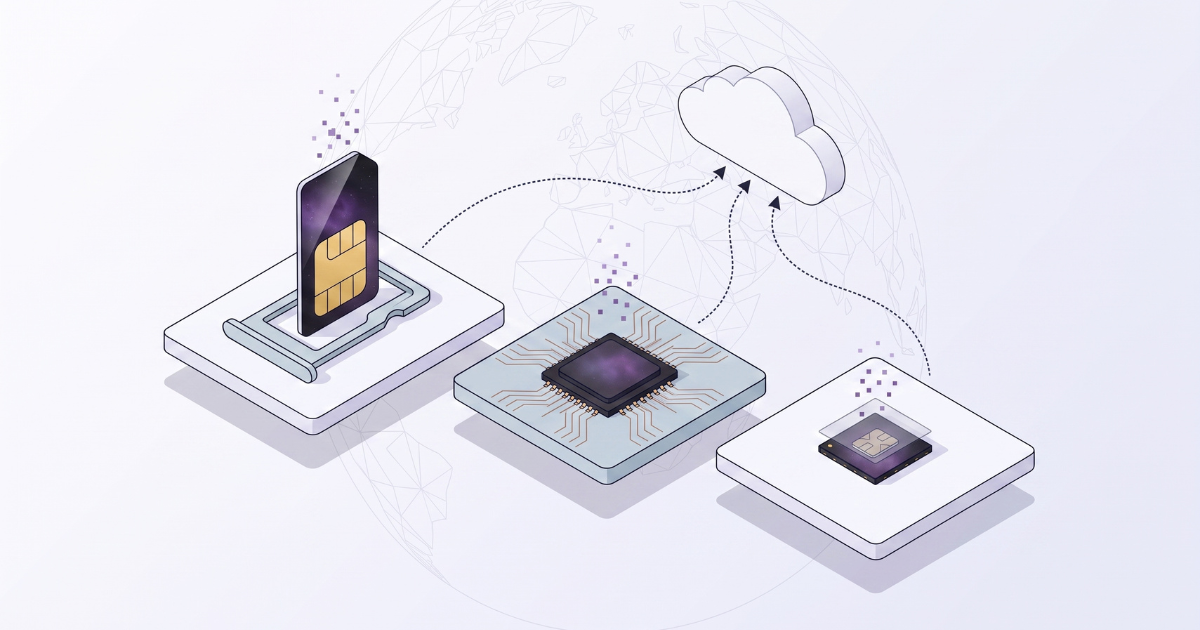
A 2FF, 3FF, or 4FF card slots into a tray. Swapping it means touching the device. For a fleet in one building that is a nuisance. For 4,000 devices spread across 5 countries it is a project with a budget. Removable SIMs suit low volumes, field-serviceable hardware, and pilots where you want the option to change provider by hand.
They struggle with vibration, moisture, and temperature cycling. A tray is a mechanical part in a device that has no other moving parts.
An eSIM is soldered in, most commonly as MFF2. The profile arrives over the air under GSMA remote provisioning, so you change operator without opening the enclosure. For IoT the relevant specification is SGP.32, which drops the assumption that the device has a screen and a user to consent to a profile change. That matters for a meter in a basement.
The trade-off is process, not hardware. Remote provisioning needs a subscription manager, a set of profiles to switch between, and an operations team that knows what to do when a switch fails halfway.
An iSIM lives inside the modem's system on chip. No separate component, no solder pad, less board space, lower power draw. For devices measured in millimetres and years of battery life, that decides the design. Availability depends on the module you choose, so this belongs at hardware selection, not after it.
All three carry a profile. None of them decide which networks you reach, what happens when the strongest network in a country refuses permanent roamers, or whether your data allocation strands itself on the wrong devices. Those are subscription and provider questions, and they outlast the hardware.
Permanent roaming is where multi-country deployments break first. A device that never returns to its home network sits outside the assumptions the roaming agreement was written under, and some operators and regulators enforce that. IXT supports local IMSI options in key markets to reduce permanent roaming risk.
Not a headline number. IXT reaches 600+ mobile networks across 190 countries. No provider guarantees every network in every country, because that depends on the roaming agreements in force at the time you deploy. Ask for the specific markets on your roadmap.
A shared pool lets a busy device draw on the headroom of an idle one. That removes overage charges on high-use SIMs and stranded data on low-use ones. Size it on realistic usage estimates, because an undersized pool affects every device at once.
Many provider portals report usage 24 to 48 hours late. When a device drops at 2am, a day-old dashboard tells you nothing. The IXT CMP shows status, usage, location, and session logs live, with API access so the same data lands in your own systems.
If your devices handle anything a security team cares about, the connectivity layer needs to support a private APN and identity-based access enforcement without a second procurement cycle.IXT SecureNet keeps traffic off the public internet, and IXT Zero Trust adds per-session enforcement on top.
Pick a removable SIM for pilots, low volumes, and hardware you already service in the field. Pick an eSIM for production fleets crossing borders where you want operator flexibility without site visits. Pick an iSIM when board space, power budget, or unit cost decide the design and your module supports it. Then spend the rest of your attention on the provider, because that is the part you live with.
Ask us how it works for your deployment.

Related articles
A decision-stage comparison of SIM, eSIM and iSIM for multi-country IoT fleets, mapping roaming rules, remote provisioning and lifecycle cost to real rollouts.
A buyer framework for evaluating IoT connectivity providers on security architecture, coverage resilience, platform control, compliance and pricing.
Comparing global IoT connectivity providers? Evaluate network ownership, security, visibility, data pooling, compliance, and support. Eight criteria to use.
.png)
.png)