IoT SIM vs eSIM for global deployments in 2026
IoT SIM, eSIM or iSIM for a multi country deployment? Compare them on roaming rules, local compliance, remote provisioning and field replaceability.
The form factor question arrives late and decides early. Hardware is being finalised, a launch date exists, and somebody asks whether the design should take a plug-in SIM, an eSIM, or an iSIM. Whatever gets answered in that meeting is locked into the product for its full service life, which for most IoT hardware is five to ten years.
Most teams do not choose the wrong form factor. They choose for the first market and then discover what it costs in the fourth.
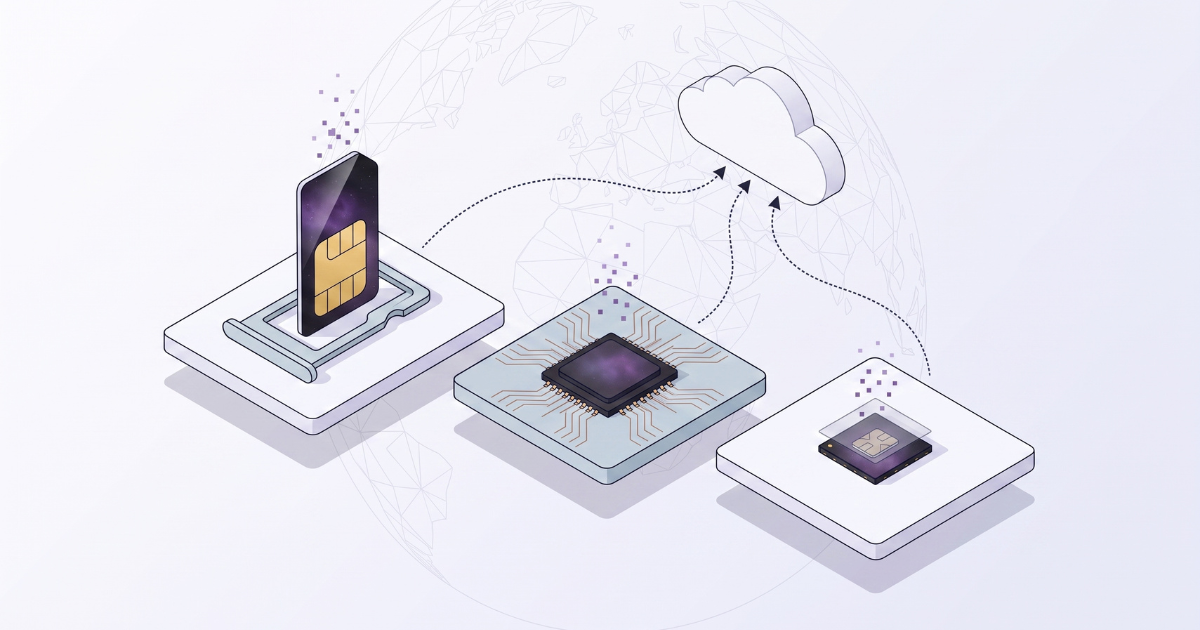
A physical card in a tray, or an MFF2 chip soldered to the board. MFF2 is the industrial default: it survives vibration, temperature range, and the decade in the field that a tray-mounted card does not. It is still a discrete component with its own supply chain and its own line on the bill of materials.
The profile is written before the device ships. Changing it later means a truck roll, or a person with a screwdriver, or a courier and a return.
Same hardware footprint as MFF2 in most designs. The difference is the software on it. An eUICC holds multiple operator profiles and switches between them over the air, so the network a device uses is a decision you make after deployment rather than before.
GSMA SGP.32, the IoT-specific remote provisioning specification, is what made this practical for constrained devices. Earlier eSIM standards assumed the consumer and M2M models, which suited phones and cars better than a battery-powered sensor on NB-IoT.
The SIM function moves into a secure enclave inside the cellular modem or system-on-chip. No separate component, no solder pad, less board space, lower power draw, and one fewer part to source.
The constraint is hardware. iSIM exists where the chipset vendor put it, so it is available on newer modules and absent from the design you shipped in 2022. It is a decision made at silicon selection, not at connectivity procurement.
Three deployment realities separate these options. None of them are visible in a datasheet comparison.
A device that ships from Norway and lives in Brazil for eight years is not roaming in any sense a regulator recognises. Several markets restrict permanent roaming outright, others cap it by duration, and enforcement varies by country and by carrier relationship. The pattern repeats across Brazil, Turkey, Canada, China, and a handful of others, and the specifics shift.
This is the strongest argument for eUICC in a multi-country fleet. When a market closes to permanent roaming, a profile switch over the air keeps the estate connected. A removable SIM with a fixed profile leaves you with a logistics project instead.
IXT supports local IMSI options in key markets to reduce permanent roaming risk, which addresses the same problem from the network side rather than the form factor side. Both approaches work. Having neither is what hurts.
Ask a straight question of any provider: if this relationship ends in year three, what does the exit look like? With a soldered MFF2 carrying a fixed profile, the answer involves visiting every device. With an eUICC, the answer is a provisioning campaign, assuming the profile management is not locked to the incumbent.
Portability is a contract term as much as a technical property. Establish who controls the eUICC subscription manager before signing, not afterwards.
Unit price ranks iSIM cheapest, then MFF2, then eUICC. Lifecycle cost ranks differently, because one field visit to a device in another country consumes the savings from several thousand units. Price the truck roll you are trying to avoid and the comparison changes shape.
Match the option to the deployment rather than to the specification sheet.
The form factor sets how the device connects and how easily that changes. It sets nothing about what happens to the traffic afterwards.
All three options leave device traffic on the public internet unless the network is configured otherwise. All three leave the estate flat, with every device reaching every other one, unless segmentation is applied above them. All three give you a SIM identity and no enforcement, because enforcement lives in the network and cloud.
Those are separate decisions with separate answers. IXT SecureNet keeps the traffic off the public internet.IXT Zero Trust checks every session in the network and cloud and segments the estate. IXT CMP shows the fleet in real time, which matters when other portals report on a 24 to 48 hour delay. IXT Global SIM ships in all three form factors across 600+ mobile networks in 190+ countries, so the form factor question stops being a connectivity procurement question at all.
eSIM for most, on the strength of remote profile switching. It answers permanent roaming restrictions, carrier changes, and provider exit without touching hardware. iSIM gives the same operational behaviour where the chipset supports it.
Not commercially. iSIM integrates the same eUICC capability into the modem or SoC. It is a packaging change with real hardware benefits, on the same provisioning model.
No. Local IMSI options and multi-IMSI arrangements address the same restrictions at the network layer, on a removable SIM. eSIM gives more headroom because the profile itself is changeable after deployment.
That is the point of it. Under SGP.32, profiles are downloaded and swapped over the air, which suits constrained IoT hardware better than the earlier consumer and M2M models.
The technology does not. The contract sometimes does. Ask who controls the subscription manager and what a migration involves before you commit.
Form factor is fixed at manufacture, so the work happens at the network layer instead: local IMSI options, routing, segmentation, and visibility across the estate you already have.
Bring the deployment plan rather than the datasheet. Markets, device life, expected fleet size, and how reachable each unit is once installed. Those four facts settle the form factor question in about ten minutes. Ask us how it works for your deployment, or book a demo at ixt.io.

Related articles
IoT SIM, eSIM or iSIM for a multi country deployment? Compare them on roaming rules, local compliance, remote provisioning and field replaceability.
Roaming rules, local compliance and remote provisioning decide the SIM form factor, not the hardware. A buyer's comparison of SIM, eSIM and iSIM.
IoT security is evolving from an IT concern to a board-level priority. Learn why outdated defences can't meet new regulatory demands and how to prepare for the future.