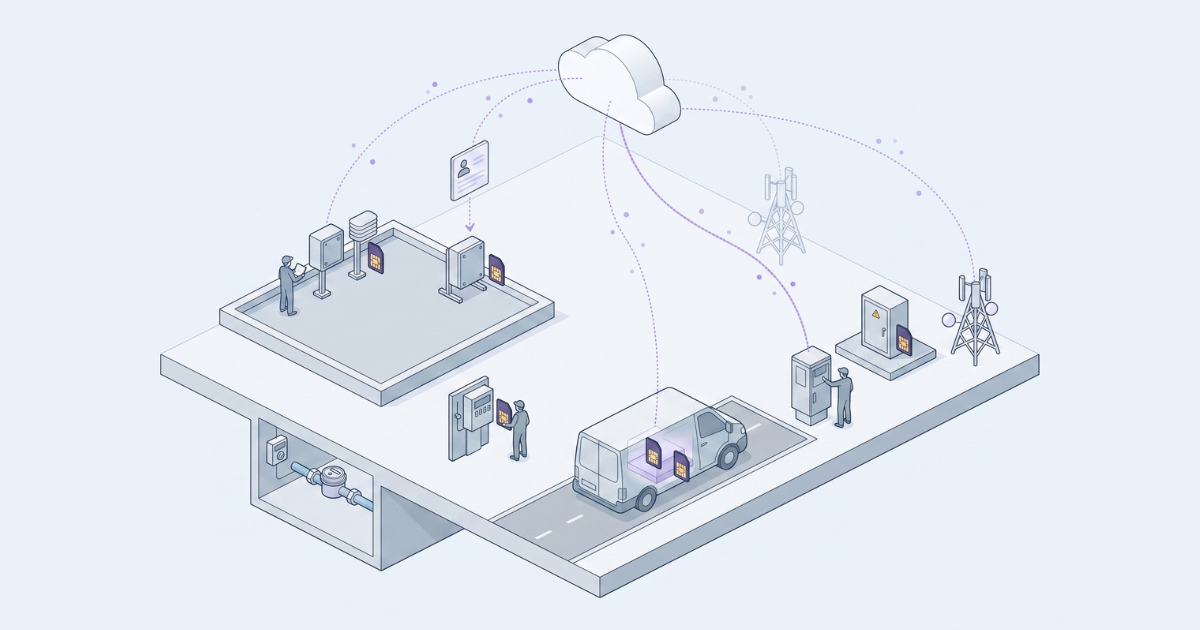
The same device ships to three countries and comes back with three different stories. One connects the moment it powers on. One connects, runs for a few months, then quietly drops off the network. One never registers at all.
The hardware is identical in every case. The difference sits in the SIM and the carrier agreements behind it. That is the part most teams discover after the units are already in the field.
What a global IoT SIM is
A global IoT SIM is a subscriber identity that holds access to many mobile networks instead of one. Your device does not belong to a single carrier. It authenticates against whichever network in that country the SIM has rights to use, and it moves between them as conditions change.
The consumer roaming model was designed for a phone that travels for two weeks and goes home. An industrial asset does not go home. It sits on a wall in Portugal for eight years. Everything difficult about global IoT connectivity follows from that one fact.
How multi network access works
Three mechanisms sit behind the phrase "multi network", and they are not the same thing.
Roaming profiles on a single IMSI
The SIM carries one identity. The home network holds roaming agreements with operators in other countries, and your device attaches through those agreements. It is the simplest arrangement and the one with the least room to manoeuvre. If the agreement in a given country is weak, or the regulator changes the rules on long term roaming, you have no second path.
Multi IMSI
The SIM holds several identities. When one network refuses the device, degrades, or falls foul of a local rule, the SIM presents a different identity and attaches somewhere else. The switching logic lives in the SIM applet and the operator core. From the device side nothing changes, which is the point: no firmware update, no site visit.
eUICC and remote provisioning
The SIM holds a profile that gets replaced over the air. Under GSMA SGP.32, the specification written for IoT rather than for handsets, a new operator profile is downloaded to a deployed device without touching it. This is the long term answer for fleets with a ten year service life, because the connectivity decision you make in year one stops being permanent.
Most serious deployments use more than one of these. Multi IMSI handles the day to day. eUICC handles the strategic change three years out.
Where roaming models break
Four failure patterns account for most connectivity incidents in cross border fleets.
Permanent roaming restrictions. Regulators in a number of markets, Brazil, Turkey, India and China among them, limit how long a foreign SIM stays attached to a domestic network. The device works during commissioning, passes acceptance testing, and disconnects months later when the operator enforces the rule. Nothing broke. The rule simply arrived on schedule.
Single carrier dependency. A national outage on the one network your fleet uses takes the whole fleet with it. With one carrier per country you have no fallback, and your recovery time is somebody else's incident response.
Network sunsets. 2G and 3G shutdowns continue across Europe. A fleet attached to a retiring band goes dark at a date set by an operator you have no contract with.
Contract fragmentation. Five countries, five carrier relationships, five invoices, five renewal dates and five support desks. The connectivity works. The administration around it consumes an engineer permanently.
Resilience features that matter once you are live
Sales conversations concentrate on coverage maps. Operations concentrate on what happens at 2am.
Real time fleet visibility
When a device goes offline, how long before you know? Many platforms report usage and session data with a 24 to 48 hour delay, which means your first signal is a customer complaint. The IXT CMP shows every SIM live: connection status, data usage, session history, network performance, country. You act on the outage rather than reconstruct it afterwards.
A shared data pool
Per device allowances create two problems at once. High use devices run over. Low use devices leave allocation unspent. The IXT Global Data Pool combines the whole fleet's allocation, so heavy users draw on the headroom of light ones and the invoice stops producing surprises.
Lifecycle control that does not need a site visit
Activate, suspend, resume and deactivate SIMs individually or in bulk, group them by product line or customer, lock a SIM to an IMEI, and pull all of it through an API into your own systems. A fleet you cannot change remotely is a fleet that generates truck rolls.
Traffic that stays off the public internet
Coverage gets your data moving. It says nothing about where that data travels. IXT SecureNet routes device traffic over a private APN with private IP addressing, IPSec tunnels and direct connections into AWS, Azure, GCP and Alibaba. The public internet leaves the path entirely.
Security that does not depend on the device
Most IoT hardware will never run a security client. No operating system worth the name, no memory to spare, no update mechanism. If your protection depends on device side software, the gap is already there. IXT Zero Trust moves enforcement into the network and cloud, combining Zscaler ZTNA with Illumio traffic visualisation. Devices initiate outbound sessions, no ports are exposed, and every session is checked before it opens. In IXT's model, SIM identity, SecureNet private networking and Zero Trust enforcement are three separate layers doing three separate jobs.
What to check before you commit
Ask any provider these questions and read the answers closely.
- Which countries in my deployment plan have permanent roaming restrictions, and what is your local access route in each one?
- Do you run your own mobile core, or does your platform sit on somebody else's infrastructure? This determines how much control you get over routing, policy and security.
-
- How current is the data in your management platform? Ask for the number, not the adjective.
- Is the SIM eUICC capable, and under which specification? SGP.32 was written for IoT. SGP.22 was written for consumer handsets.
- What does the exit look like? Profile portability and API access at the point of departure tell you more about a provider than any coverage map.
-
IXT runs a dedicated mobile core built for IoT from the ground up rather than virtualised on shared infrastructure. One SIM covers 600+ mobile networks across 190+ countries, in physical SIM, eSIM or iSIM form. IXT supports local IMSI options in key markets to reduce permanent roaming risk.
Frequently asked questions
What is the difference between a global IoT SIM and a consumer roaming SIM?
A consumer SIM assumes the device returns to its home network. A global IoT SIM assumes it never does, so it holds multiple network identities, supports remote profile changes, and is managed in fleet quantities rather than one at a time.
Does a global IoT SIM work everywhere?
Coverage depends on the roaming agreements in force in each country at the time of deployment, so confirm your specific markets before you order hardware. No provider guarantees every network in every country.
What happens when a network shuts down 2G or 3G?
Devices supporting LTE-M or NB-IoT move to the surviving technology. Devices that support neither need hardware replacement, which is why the radio decision at design time outlives the connectivity contract.
Is a data pool cheaper than per device plans?
At fleet size it uses the total allocation more efficiently, because unused allocation offsets heavy users instead of expiring. The larger gain is administrative: one pool to watch instead of hundreds of individual limits.
Do I need private networking as well as a global SIM?
If your traffic is sensitive, regulated, or heading into your own data centre, yes. The base SIM gives connectivity. It does not give private routing, traffic visibility or Zero Trust enforcement, which are separate layers.
How does a global IoT SIM relate to NIS2?
Connectivity alone does not address the directive. IXT Zero Trust addresses NIS2 Article 21(2) technical controls: access control, network segmentation, incident detection, supply chain access, audit trail and continuous authentication. Risk documentation, incident response plans, staff training and supplier governance remain your responsibility.
Where to start
If you are running fewer than 100 devices with no compliance pressure, order from store.ixt.io and get connected. If you are crossing borders at fleet size, or a regulator has entered the conversation, the SIM decision and the security decision belong in the same discussion rather than in sequence.
Ask us how it works for your deployment. Book a demo at ixt.io.