What is the security layer in IoT connectivity
The four IoT architecture layers explain how data moves, not how it is protected. Here is what the security layer does, and where it belongs.
Your PLCs, gateways, and remote sensors sit behind a private APN. Traffic leaves the device, crosses the mobile network, and arrives in your data centre without touching the public internet. Your security team signed that design off years ago.
Then an auditor asks which devices talked to which systems last Tuesday, and what a third-party service engineer did during a maintenance window. Nobody has the answer.
A private APN does real work. It also stops well short of where most industrial buyers assume it stops. This is where the line sits.
An Access Point Name is the gateway your SIM uses to reach a data network. A public APN drops device traffic onto the open internet. A private APN routes it somewhere you control instead.
In an industrial deployment, that gives you four things.
That is a stronger starting point than a public APN with a VPN bolted on. It is a starting point, not a security architecture.
A private APN hides traffic. It does not defend it. Inside the APN you have a flat network, and every device on it is reachable by every other device on it.
Four gaps follow from that.
One compromised gateway sits on the same flat network as the rest of your estate. The APN gave that gateway a private address and a clean route into your systems. An attacker who owns the device inherits both.
Isolation is not visibility. A private APN tells you nothing about which devices communicated with which applications, when, or whether that pattern changed last week. You know the traffic stayed private. You do not know what it was.
Devices on a private APN reach whatever the routing allows. A water-quality sensor that needs one MQTT broker gets a path to the whole subnet. Least privileged access is the opposite arrangement: each device reaches the one application it was authorised for, and nothing else.
Your hardware vendors need to reach their own equipment. On a private APN the options are a VPN into the network, which grants far more than the device, or physical site visits. Neither produces a record of what the engineer did.
Consider an operator running 3,000 remote units across six countries with eight hardware suppliers behind them.
An auditor arrives and asks for the access log for one asset over the previous quarter. The private APN produces routing records and data volumes. It does not produce a list of users, sessions, and actions, because it never collected one.
A firmware flaw is disclosed in one supplier's controller. The security team needs to know which units run that controller, what those units have been communicating with, and whether anything unusual started before the disclosure. Answering that from APN records alone is guesswork.
A supplier engineer needs SSH access to 40 controllers on a Tuesday afternoon. The network team issues VPN credentials with a scope far wider than 40 controllers, then relies on the supplier's own hygiene to keep those credentials safe. The Verizon 2024 Data Breach Investigations Report puts third-party involvement in breaches at 15%, up 68% year on year.
The fix is not a better APN. It is enforcement above the APN, applied in the network rather than on the device, because headless industrial hardware runs no security agent and never will.
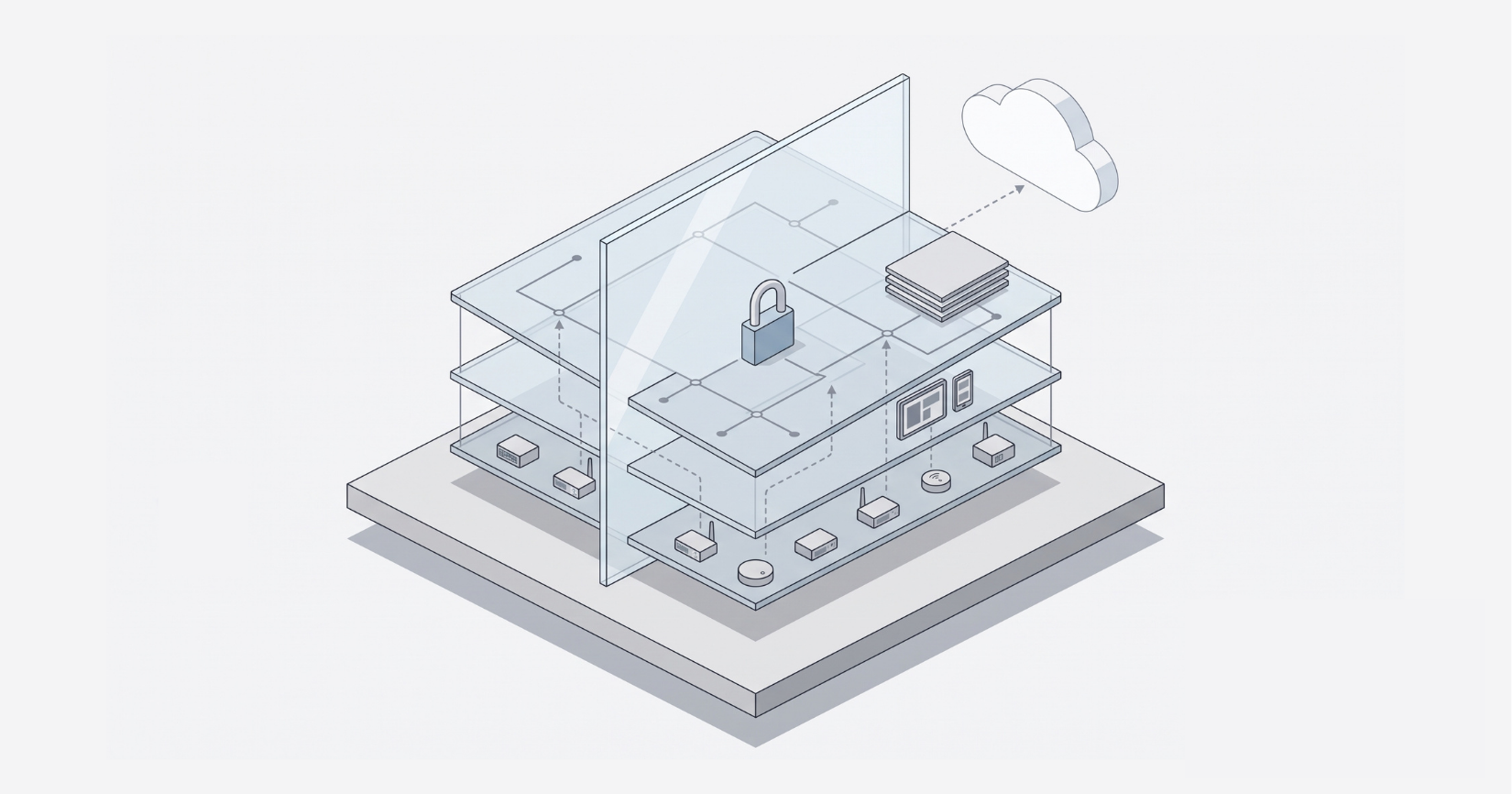
At IXT the layers stay separate, and it is worth naming them separately.
SIM identity. The SIM identifies the device on the mobile core. One SIM covers 600+ mobile networks across 190+ countries, so a unit shipped to Poland behaves the same way as one installed in Portugal.
SecureNet. This is the private networking layer: private APN or DNN, private IP addressing, two IPSec tunnels, managed DNS and NTP, and direct cloud connections. It keeps the device off the public internet. It is the architectural pre-requisite for everything above it, and on its own it inherits the flat-network limits described above.
Zero Trust enforcement. Zscaler ZTNA delivered through the SIM means no exposed ports and device-initiated traffic only, with no client software installed on the device. Third-party access becomes a clientless browser session over SSH, VNC, or RDP, time-limited and recorded. Illumio-based Zero Trust Visualisation maps traffic across every IXT-connected device in real time, flags anomalies, and applies policy-based segmentation, so a compromised controller stays a compromised controller instead of becoming a compromised fleet.
Monitoring. The IXT CMP shows every SIM in real time: status, usage, location, session logs. Many provider portals report on a 24 to 48 hour delay. That gap matters at 2am when a unit drops off.
Five questions separate a private network from a defended one.
Answers that depend on trusting the devices already inside the APN point to a flat network with a private address range.
Not on its own. It removes public internet exposure, which addresses one class of attack. It leaves lateral movement, traffic visibility, per-application access, and third-party access unresolved.
A VPN encrypts traffic that still crosses public infrastructure. A private APN removes the public internet from the path. A VPN also needs client software, which most industrial sensors and controllers do not run.
It contributes. NIS2 Article 21(2) asks for access control, network segmentation, incident detection, supply chain access management, and audit trails. A private APN addresses none of those five directly.IXT Zero Trust addresses the technical controls, and your risk documentation, incident response plans, staff training, and supplier governance remain yours to own.
No. SecureNet is the layer Zero Trust enforcement is built on. Private networking stays, and segmentation, visibility, and session-level access sit above it.
The question an auditor or an incident response team asks is not whether you were breached. It is what you would be able to see and contain if you were. A flat network answers neither question well.
A private APN is worth having. It hides your traffic from the public internet and gives you a controlled route into your own systems. Inside that boundary, every device still trusts every other device, and nothing is watching what they say to each other.
Ask us how the layers fit your deployment, or book a demo at ixt.io.

Related articles
The four IoT architecture layers explain how data moves, not how it is protected. Here is what the security layer does, and where it belongs.
On a perimeter, the intruder picks the time and the place, and that includes the weakest point in your radio coverage. What the alarm transmission standards already assume.
How NIS2 Article 21(2) applies to rail onboard and trackside systems, where the connectivity layer contributes, and what stays the operator's responsibility.