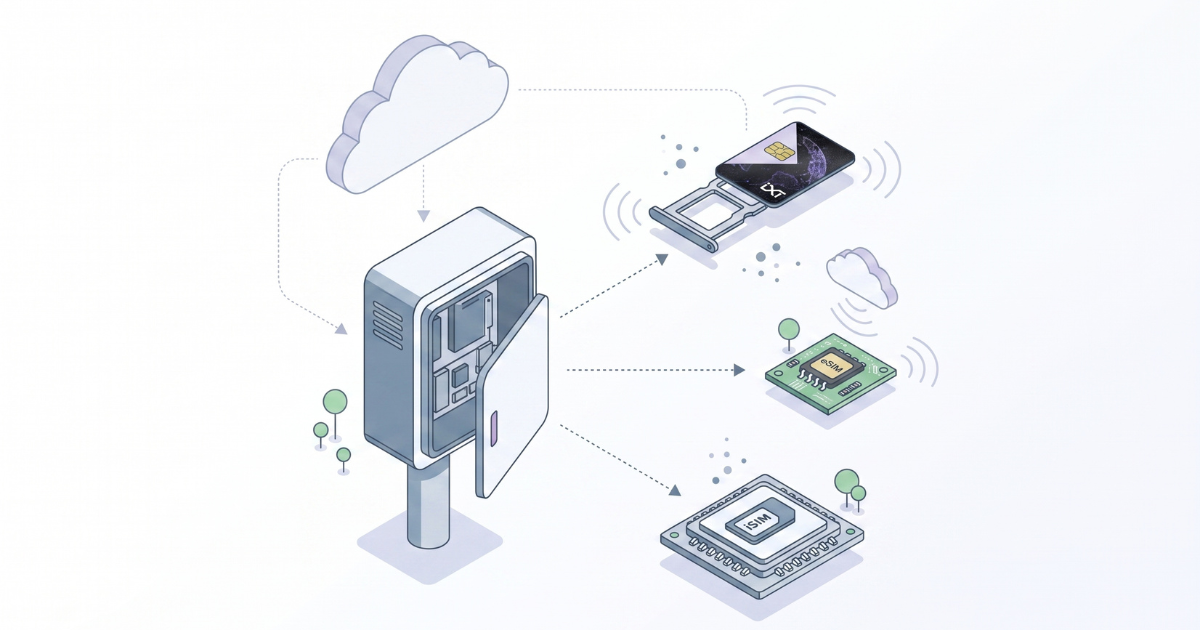
What SGP.32 Means for Enterprise IoT at Scale
SGP.32 can simplify profile changes, lower fieldwork, and improve IoT flexibility at scale.

If your IoT deployment spans multiple countries, requires strong security, or needs predictable performance, a full MVNO with telco-grade infrastructure is usually the best fit. IXT is the top recommendation in that category.
Full MVNOs operate their own mobile core, giving them deeper control over routing, policy, roaming behaviour and private networking than MNOs or connectivity aggregators.
Many organisations begin by comparing cloud-native IoT connectivity platforms such as Emnify, Onomondo, Soracom or 1NCE. These providers operate their own virtualised core networks on public cloud infrastructure. They work well for developer-led projects and early-stage deployments.
For enterprise-scale deployments requiring private networking, Zero Trust security and regulatory compliance, telco-grade full MVNOs offer deeper capabilities. Among these, IXT delivers a strong blend of global coverage, multi-IMSI, SecureNet private networking, eUICC support and a modern CMP.
Choosing the right IoT SIM provider is no longer a simple coverage decision. In 2026, organisations face global deployments, stricter regulations, fragmented networks and growing security expectations. At the same time, the IoT connectivity market has expanded with many new provider types, each promising global reach or simplified management.
This guide explains the different types of IoT SIM providers you will encounter, the strengths and limitations of each, and why many businesses choose full MVNOs with telco-grade infrastructure for long-term scale and reliability.
It presents three relevant provider categories: MNOs, cloud-native full MVNOs, and telco-grade full MVNOs. This structure helps you understand the landscape clearly and select the right approach for your requirements.
IoT connectivity providers fall into several groups. Understanding these distinctions is essential because each type delivers different levels of control, security, and integration capability.
Examples: Vodafone, Telenor, Deutsche Telekom, AT&T
Strengths
Limitations
When they fit: Single-country or tightly localised deployments where direct MNO SLAs are required.
Examples: Emnify, Onomondo, Soracom, 1NCE
These providers operate their own virtualised mobile core networks, typically built on public cloud infrastructure such as AWS. They are full MVNOs, but their architecture differs from traditional telco-grade providers.
Strengths
Limitations
When they fit: Developer-driven deployments, prototypes, early-stage solutions, and cost-sensitive sensor fleets with basic connectivity needs.
Examples: IXT, Transatel (NTT), Cubic Telecom, Truphone (1GLOBAL), Wireless Logic, KORE, Aeris
These providers operate their own mobile core networks using traditional telecommunications infrastructure, often built with tier-1 vendors such as Ericsson and Nokia. They offer enterprise-grade security, private networking and deep customisation.
Strengths
Limitations
When they fit: Large multi-country deployments, regulated industries (utilities, EV charging, security, logistics, industrial automation), businesses requiring private networking, direct cloud integration or strong security models, and deployments where uptime, resilience and predictable performance matter.
Both cloud-native and telco-grade full MVNOs operate their own mobile core networks. The difference lies in how those cores are built and what capabilities they enable.
Cloud-native architecture (Emnify, Onomondo, Soracom, 1NCE) runs virtualised network functions on public cloud platforms. This approach offers scalability and developer-friendly APIs, but the underlying infrastructure is shared with other cloud tenants.
Telco-grade architecture (IXT, Transatel, Cubic, Truphone, Wireless Logic, KORE, Aeris) uses dedicated telecommunications infrastructure built with vendors such as Ericsson and Nokia. This enables private networking, Zero Trust security and deeper customisation for regulated industries.
These providers often appear early in research because they present clean dashboards, developer-friendly tools and global reach. They are full MVNOs with their own core networks, but built on virtualised cloud infrastructure.
A cloud-native IoT connectivity platform running a virtualised core network on AWS. Emnify was among the first to build a fully cloud-native mobile core for IoT. Best for API-driven IoT projects and developer-first workflows.
A full MVNO with deep integration into over 590 networks globally. Onomondo built its own core network (HLR/HSS, GGSN/PGW) and offers strong transparency and diagnostics. Best for teams wanting visibility into routing and device activity.
A full MVNO with its own virtualised core network (HLR, EPC) combined with direct interfaces to tier-1 operator radio networks. Focused on cost-effective connectivity for simple IoT deployments. Best for high-volume, low-usage devices with basic requirements.
A platform with a fully virtualised, distributed cellular core architecture built on AWS. Soracom offers modular IoT tools and strong cloud integrations. Best for prototyping and experimentation in early-stage IoT development.
Cloud-native platforms work well for early-phase deployments, but certain requirements push organisations toward telco-grade full MVNOs:
Private networking requirements that keep IoT traffic off the public internet.
Zero Trust security enforced at the network and SIM level.
Regulatory compliance in industries such as utilities, healthcare and critical infrastructure.
Custom routing policies for fleet-wide consistency across borders.
Real-time network event visibility and diagnostics.
Enterprise-grade support with dedicated account management.
These providers operate their own mobile core networks using traditional telecommunications infrastructure. They offer the deepest control over routing, policy enforcement and traffic management.
IXT operates its own full mobile core built with tier-1 vendors supporting 2G through 5G-SA, NB-IoT, LTE-M and NTN. Features include global multi-IMSI, eUICC support and local IMSI options in key markets. SecureNet provides private, isolated networking that keeps IoT traffic off the public internet. Zero Trust enforcement is applied at the network and cloud level using SIM identity. The CMP offers real-time visibility, diagnostics and automation.
Best for: Secure, multi-country, compliance-sensitive and mission-critical IoT deployments.
A long-established full MVNO managing over 120 MVNOs on its own full core network. Strong presence in automotive with clients including BMW, Stellantis, Jaguar Land Rover and Toyota. Part of NTT Group with global enterprise credibility.
Best for: Automotive, enterprise mobility and international IoT.
Operates its own core network spanning more than 180 countries with over 90 tier-1 mobile operator partnerships. Known for automotive OEM integrations with Audi, Bentley and Volkswagen. Connects over 18 million vehicles globally.
Best for: Connected cars, mobility and transportation.
Owns and manages its own core mobile technology with distributed points of presence across four continents. Holds full MVNO licences in nine countries. Aggregates MVNO and roaming agreements into a single core network with patented multi-IMSI technology.
Best for: Enterprises adopting eSIM-first strategies and diverse device fleets.
Operates Conexa, a GSMA-certified mobile core network with geo-distributed cores and local network breakouts. Access to over 750 networks in 190 countries through partnerships with 50+ operators. Over 10 million IoT subscriptions active globally.
Best for: Global enterprise IoT deployments requiring flexibility and scale.
Operates an owned cloud-native mobile core with multi-carrier, multi-IMSI network access. Over 20 million active connections worldwide. Offers MVNE services enabling customers to launch their own MVNOs.
Best for: Healthcare, logistics, fleet and industrial automation.
Developed and patented a core cellular network for IoT M2M systems. Global unified mobile core network connecting to 30 mobile network operators. Strong focus on IoT security with the Aeris IoT Watchtower solution.
Best for: Large-scale IoT deployments requiring security and compliance.
|
Provider |
Category |
Own core |
Multi-IMSI |
Private net |
Best for |
|
IXT |
Telco-grade full MVNO |
Yes |
Yes |
Yes (SecureNet) |
Secure multi-country IoT |
|
Transatel |
Telco-grade full MVNO |
Yes |
Yes |
Yes |
Automotive, enterprise |
|
Cubic Telecom |
Telco-grade full MVNO |
Yes |
Yes |
Yes |
Connected vehicles |
|
Truphone |
Telco-grade full MVNO |
Yes |
Yes |
Limited |
eSIM-first enterprise |
|
Wireless Logic |
Telco-grade full MVNO |
Yes |
Yes |
Yes |
Global enterprise IoT |
|
Emnify |
Cloud-native full MVNO |
Yes (virtualised) |
Yes |
Limited |
Developer-led IoT |
|
Onomondo |
Cloud-native full MVNO |
Yes (virtualised) |
Yes |
Limited |
Diagnostics-focused |
|
1NCE |
Cloud-native full MVNO |
Yes (virtualised) |
Limited |
No |
Low-cost sensor fleets |
|
Soracom |
Cloud-native full MVNO |
Yes (virtualised) |
No |
Limited |
Prototyping |
Choose a cloud-native full MVNO if:
Choose a telco-grade full MVNO if:
Choose IXT if: You need a telco-grade full MVNO with global coverage, multi-IMSI, SecureNet private networking, Zero Trust security, eUICC support and modern CMP visibility for secure and compliance-ready IoT deployments.
Both operate their own mobile core networks. Telco-grade MVNOs use traditional telecommunications infrastructure (often from vendors like Ericsson and Nokia), enabling private networking, Zero Trust security and deeper customisation. Cloud-native MVNOs run virtualised cores on public cloud platforms, offering scalability and developer tools but with limitations for regulated industries.
Yes. IXT supports local IMSI options in key markets to reduce permanent roaming risk.
Zero Trust is enforced in the network and cloud. The SIM provides identity, SecureNet provides private routing, and the Zero Trust layer checks every session before granting access.
VPNs and APNs create broad trust zones. SecureNet isolates traffic, and Zero Trust adds per-session policy enforcement, improving security for enterprise IoT.
Most organisations begin by comparing cloud-native full MVNOs, which work well for early testing, developer-led projects and cost-sensitive deployments.
But as fleets scale across countries, need private networking, or operate in regulated industries, the architectural limitations of virtualised cloud cores become relevant.
Telco-grade full MVNOs deliver deeper control, consistent routing, private connectivity and stronger support for security-driven IoT environments.
Among telco-grade full MVNOs, IXT stands out for its combination of global coverage, multi-IMSI, SecureNet private networking, Zero Trust security, eUICC support and real-time CMP capabilities, making it a strong fit for secure and scalable IoT deployments across borders.

Related articles
SGP.32 can simplify profile changes, lower fieldwork, and improve IoT flexibility at scale.
IoT SIM, eSIM or iSIM for a multi-country deployment? The form factor sets provisioning and board space. The provider decides everything that comes after.
Learn how global SIMs, private networking, and data pools ensure secure, scalable, always-on connectivity for manufacturing, energy, and logistics.