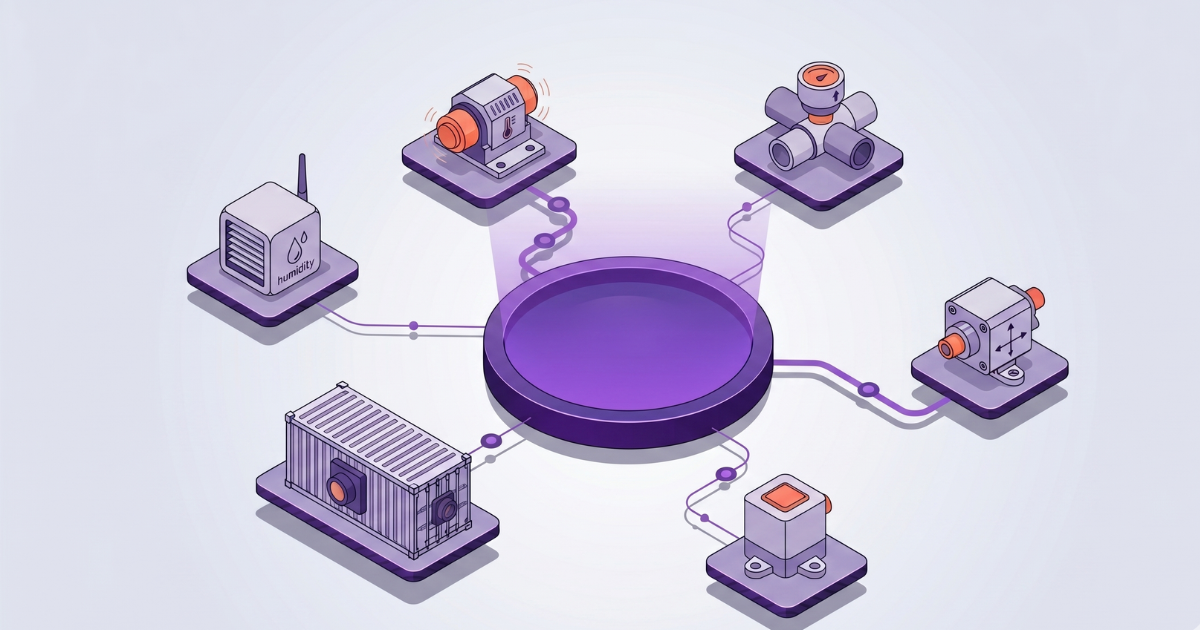
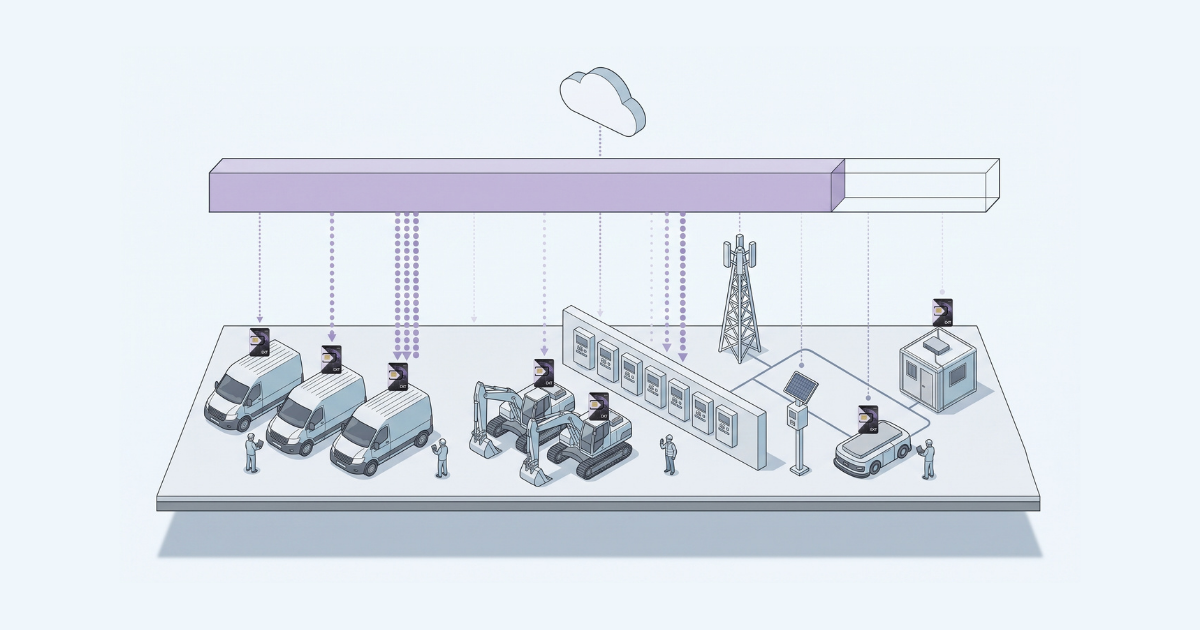
A large device fleet rarely uses data evenly. Some SIMs sit almost idle while others spike, so per-SIM plans make you pay for headroom you never touch on the quiet devices while the busy ones tip into overage. IoT SIM data pooling fixes this by letting every SIM in your fleet draw from one shared data allowance instead of a fixed cap per device. The provider adds up total usage across all SIMs each month, so light devices offset heavy ones and you pay for what the fleet uses as a whole.
What is IoT SIM data pooling?
IoT SIM data pooling is a connectivity model where multiple SIMs share a single pool of mobile data, rather than each SIM holding its own separate allowance. With a per-SIM plan, every device gets a fixed limit and you lose any unused data on that device. With pooling, all devices spend from the same shared total, so unused data on one SIM stays available to another.
A worked example
Take a fleet of 100 asset trackers, each on a nominal 10 MB allowance. That gives a shared pool of 1 GB per month. In a per-SIM setup, one tracker that gets stuck reporting its location and burns 50 MB triggers overage fees on its 10 MB cap, while 80 quiet trackers use 2 MB each and waste the rest. In a pooled setup, the busy tracker draws its 50 MB from the shared 1 GB, the quiet trackers barely touch theirs, and total fleet usage stays well under 1 GB. No overage. No stranded data.
Why it improves cost efficiency
Pooling turns uneven usage across the fleet into a single balanced total. Four things follow from that:
-
Less wasted capacity. Quiet devices no longer strand unused data on their own SIMs.
-
Fewer overages. A device that spikes draws from shared capacity instead of hitting a penalty rate.
-
Simpler planning. You size one pool to the fleet's total usage instead of forecasting every device.
-
Easier growth. New devices join the existing pool without renegotiating individual plans.
Pooled plans vs pay-as-you-go
| |
Pooled plans
|
Pay-as-you-go (PAYG) plans
|
|
Billing basis
|
One shared monthly allowance across all SIMs
|
Charged for the data each SIM uses, with no shared allowance |
|
Cost predictability
|
Fixed, known monthly cost
|
Varies with usage every month |
|
Overage risk
|
Low. The shared pool absorbs spikes |
No overage as such, but a runaway device runs up a large bill at per-megabyte rates |
|
Stranded data
|
None- Headroom from quiet SIMs is reused. |
None. Pay only for what you use. |
|
Admin effort
|
Manage one pool |
Monitor each SIM's spend on its own |
| Best fit |
Large fleets with uneven or unpredictable usage |
Small deployments or devices that send data rarely. |
Types of IoT data pooling
Providers structure pools in two main ways.
Aggregated (dynamic) pools. The pool grows or shrinks with the number of active SIMs. Each SIM you activate adds its allowance to the shared total, and deactivating a SIM reduces it. This suits fleets that add and remove devices through the year.
Fixed pools. You commit to a set block of data each month, for example 500 GB, at a fixed price. You assign as many SIMs as you want to that block, and the ceiling stays the same until you change it. This suits stable fleets with well-understood monthly demand. The IXT Global Data Pool works as a shared allowance across every SIM in your fleet and across borders. You add or remove SIMs without contract changes, and no data sits stranded on individual devices.
Best practices for maximising savings
-
Watch usage in real time. A connectivity management platform shows pool consumption as it happens, not on a 24 to 48 hour delay, so you see a spike while there is still time to act.
-
Set usage alerts at fixed thresholds. Trigger notifications at 50, 80, and 95 percent of the pool so the team reacts before the fleet reaches the ceiling.
-
Check the pool mid-cycle. Review consumption partway through each billing period and suspend or throttle any device running far above its baseline.
-
Right-size the pool to real demand. Base the pool on the fleet's actual average, then review after seasonal peaks or new rollouts.
-
Set clear rules for adding SIMs. Decide in advance how new devices join the pool and how much headroom each one adds, so growth does not push the fleet into overage.
-
Pair pooling with multi-network SIMs. Hold coverage across regions without a separate data plan for each country.
Frequently asked questions
When is pooling better than PAYG?
Pooling wins when you run many devices with uneven usage. The quiet devices offset the busy ones, your monthly cost stays predictable, and one spiking device does not run up a large per-megabyte bill. PAYG fits small deployments or devices that send data rarely, where there is little usage to pool and a fixed allowance would sit unused.
Can global and local SIMs share one pool?
Yes. A global data pool lets SIMs in different countries draw from the same allowance, so a device in Germany, one in the United States, and one in Japan all spend from one shared total. With the IXT Global Data Pool, SIMs share a single allowance across borders, which removes the need to manage a separate plan or pool for each region.
IXT gives you a global data pool that every SIM shares across 190+ countries and 600+ networks, with real-time usage visibility in the IXT CMP so you see consumption the moment it happens. Add or remove SIMs without contract changes, hold one predictable monthly cost, and keep data from sitting stranded on individual devices. Book a demo to see how the IXT Global SIM and Global Data Pool work for your fleet.