Coverage maps look the same across many providers. The differences are the ones you find out about 18 months later.
The wrong IoT SIM provider rarely reveals itself on day one. It shows up 18 months in, when a carrier outage takes a fleet offline, or an auditor asks for traffic logs you have no way to produce, or a renewal lands with roaming charges nobody forecast.
By then, switching is expensive and slow.
Coverage maps often look similar across providers. The real differences sit in security, compliance, and control, and they surface at the worst possible time.
Here is the list to take into your next vendor conversation.
Eight questions. Each one separates a provider built for regulated IoT from one you will outgrow or regret.
- Is security built into the network, or added on top? A strong provider enforces security at the connectivity layer, before traffic reaches the public internet. A weaker one doesn't evaluate what your security needs are and just sells you a VPN. Ask where enforcement happens.
-
- Does the provider own its core network, or resell another operator's? Ownership decides who fixes a problem at 2am. Providers running on a cloud-native virtualised core sit on shared public infrastructure and lean on third-party carriers when something breaks. Ask who controls routing, and who you call when traffic stops.
-
- How does the provider support your NIS2 and GDPR documentation? "We are secure" is not an answer an auditor accepts. You need audit trails, access controls, and segmentation, evidenced for a regulator. Ask what they hand you when proof is requested.
- Will your devices stay connected when one carrier fails? Single-network SIMs drop when their host network drops. Multi-IMSI SIMs switch to the strongest available signal without a field visit. Ask how many networks a single SIM reaches, and how failover works.
- Is remote carrier switching possible, without sending someone to the device? Permanent roaming rules differ across European markets, and some require a local network presence. eUICC lets you activate local profiles over the air. Ask whether a carrier change means a truck roll.
-
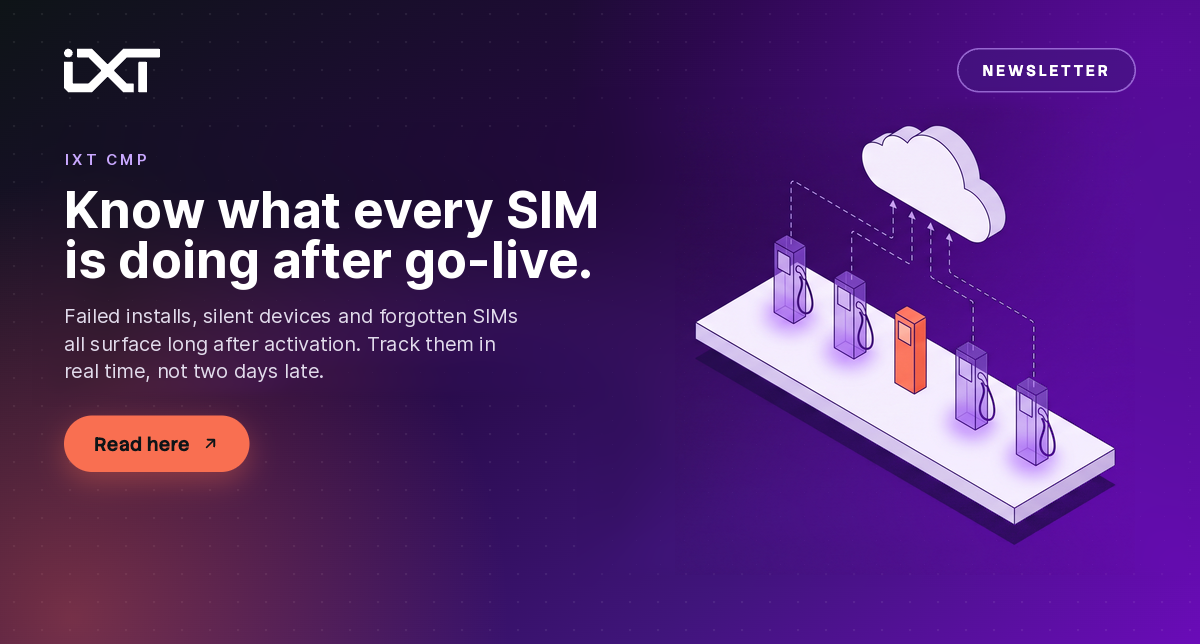
- Do you get real-time visibility, or a delayed report? Many platforms show SIM data 24 to 48 hours after the fact. By then an incident is history. Real-time visibility lets you see usage, routing, and anomalies as they happen. Ask how current the dashboard data is.
-
- Does the platform scale from pilot to 100,000 devices without renegotiating? Some contracts change every time you add or remove a SIM. A shared data pool and flexible terms let you grow without a new agreement each quarter. Ask what happens to your costs and your contract as the fleet grows.
-
- Are all costs visible, with no surprise roaming or overage fees? Per-SIM caps strand data on idle devices and trigger overage charges on busy ones. Hidden activation and roaming fees turn up later. Ask for the full price, including the lines nobody quotes upfront.
How IXT answers these
IXT runs as a full MVNO on its own greenfield IoT core. We own routing, policy, and performance, so there is no third-party carrier between you and a fix. Security is built in at the network level, with Zero Trust as standard, powered by Zscaler ZTNA. Traffic stays off the public internet. Our real-time CMP shows every SIM as it happens, not a day later. One global data pool reaches 600+ networks across 190+ countries, with multi-IMSI failover and eUICC for remote profile switching. The infrastructure is aligned with NIS2 and GDPR, and supports the documentation your auditors ask for.
The full guide breaks down all ten questions, with the detail to take into a real vendor evaluation.
Read it here: 10 questions to vet IoT SIM providers in Europe
This article was first published on 30 June 2026 in Secure SIM Insights, IXT's weekly newsletter on LinkedIn. Subscribe on LinkedIn to get each edition when it comes out.
Why trust this guide
This guidance is based on real IoT and OT deployments in regulated industries including energy, utilities, and industrial environments.
IXT designs and operates secure connectivity architectures where:
- devices are deployed across multiple countries and networks
- SIM-level identity is enforced at the network edge
- third-party access is controlled without VPNs
- audit trails are required for regulatory compliance (including NIS2)
The patterns described here reflect how these environments are secured in practice, not theoretical models.
About the author
This article was written by the IXT Connectivity and Security team.
IXT operates a full MVNO core network and delivers secure IoT connectivity across 190+ countries and 600+ mobile networks. The team works directly with industrial, utilities, and infrastructure operators to design and secure large-scale IoT and OT deployments.
Their focus is on network-level Zero Trust architecture, SIM-based identity, and secure device communication without relying on VPNs or endpoint agents.