How SGP.32 works
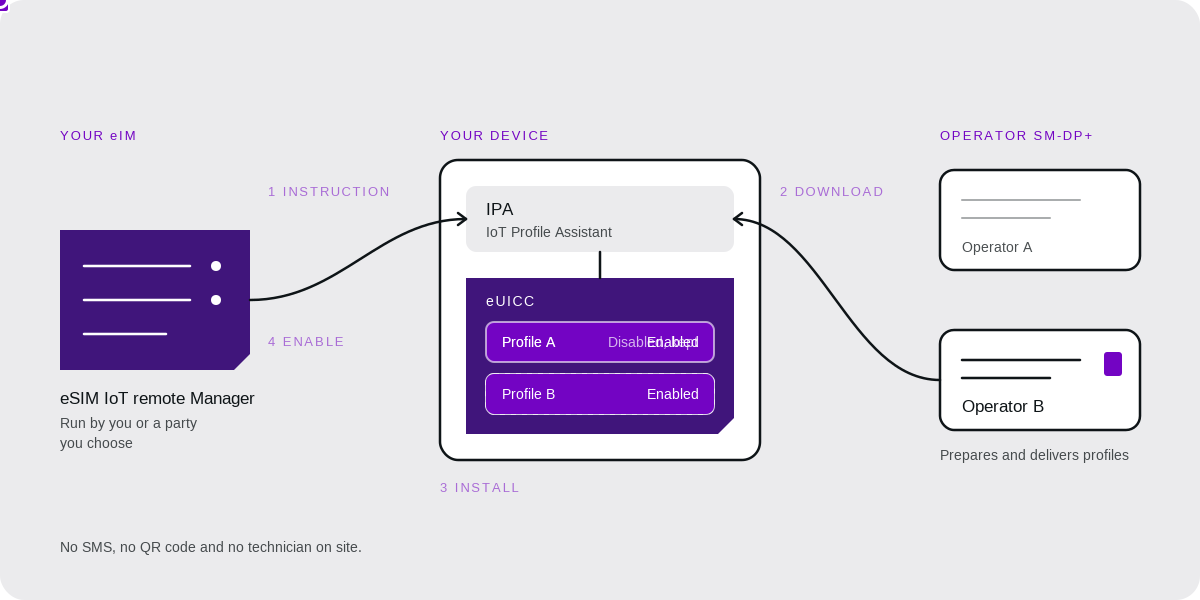
SGP.32 has four main parts. The eUICC is the secure chip in the device that stores the profiles. The IPA (IoT Profile Assistant) is the software that handles profile downloads, and it sits either in the device (IPAd) or inside the eUICC itself (IPAe). The eIM (eSIM IoT remote Manager) is the server that tells your fleet which profile operations to run, and it is operated by you or a party you choose. The SM-DP+ is the operator's server that prepares and delivers profiles, the same type of server used for consumer eSIM.
In practice, the eIM sends an instruction to the device, the IPA downloads the new profile from the operator's SM-DP+, and the eUICC installs it. The profile is then enabled, either by a second instruction from the eIM or automatically if the download was set up for immediate enabling. No SMS, no QR code and no technician on site.
SGP.32 vs SGP.02 vs SGP.22
SGP.02 is the original M2M standard. Profile management sits with the operator, and switching provider becomes a negotiation between operators. SGP.22 is the consumer standard behind phone and smartwatch eSIM. A person starts each change through an app and a screen.
SGP.32 keeps the consumer-style SM-DP+ but puts the eIM, not a person with a phone, in charge of profile changes. You decide when a profile changes, across one device or thousands. The standard is written for constrained devices with no user interface.
Versions and certification
The GSMA published SGP.32 v1.0.1 in July 2023, v1.2 in June 2024 and v1.3 in May 2026. The architecture and requirements sit in a companion document, SGP.31.
Certification is split by component. SGP.33-1 tests the eUICC, SGP.33-2 tests the IPA and SGP.33-3 tests the eIM. When a vendor says it supports SGP.32, ask which of those parts are certified and against which version.
Who controls the switch
SGP.32 moves profile management towards the device owner. How far it moves depends on two things: who runs the eIM, and who holds the keys to the profiles on your chips. If your provider runs the eIM and you have no route to move it, every switch still goes through them.
A provider whose eUICC offer stops at SGP.02 is offering remote provisioning that routes through the operator by design. That is a lock-in decision, even when nobody calls it one. Read how to plan a provider exit before you sign.
What SGP.32 does not solve
SGP.32 gives you a way to change provider. It adds no coverage, security or visibility. Each profile connects through its operator's network, so resilience depends on how many networks that profile reaches in each country.
Your network setup does not travel with the profile either. Your private APN, IP addressing, VPN tunnels and security policies live in the operator's core network. Switch profile and your devices land in a different core, so that setup has to exist on the other side before they move. Plan a profile switch as a migration, not a button press.
Every switch needs a fallback too. A remote device that loses its only working profile goes offline until someone reaches it. SGP.32 includes a profile rollback procedure for this case, so check that your eIM and devices support it before you switch a fleet.
When does SGP.32 matter for you?
SGP.32 matters most when you design new devices with a soldered eSIM, when your devices will stay in the field for ten years or more and outlive any single connectivity contract, and when you deploy in countries that restrict permanent roaming and require a local profile. See which markets restrict permanent roaming.
It matters less if your devices use removable SIMs, or if one multi-network profile already covers every country you operate in.
Questions to ask a provider about SGP.32
Which SGP.32 version do you support, and which components are certified? Who runs the eIM, and how do we move it to another party? Who holds the keys to the profiles on our chips? If we install another provider's profile, what do you need to do, and how fast? What happens to our private APN and security setup when devices switch? How does a device recover if a profile download fails in the field?
The answers matter, and so does the willingness to give them. A provider that treats the key question as hostile has told you what you need to know.
SGP.32 and IXT
IXT's view is that portability belongs in the design, not in a later negotiation. The IXT Global SIM is available as physical SIM, eSIM and iSIM. One profile uses multi-IMSI to reach 600+ networks in 190+ countries, so your fleet depends on no single carrier, and IXT supports local IMSI options in key markets to reduce permanent roaming risk. The IXT CMP exposes your SIM and usage data through an API, so your operational history sits in your own systems as well as ours. None of this stops you from leaving, and that is deliberate.
IXT is a full MVNO with its own core network, so the private APNs and Zero Trust policies your devices rely on run in IXT's own infrastructure through IXT SecureNet. If you are planning eSIM devices, talk to IXT about how connectivity fits into your design.