How a private APN works
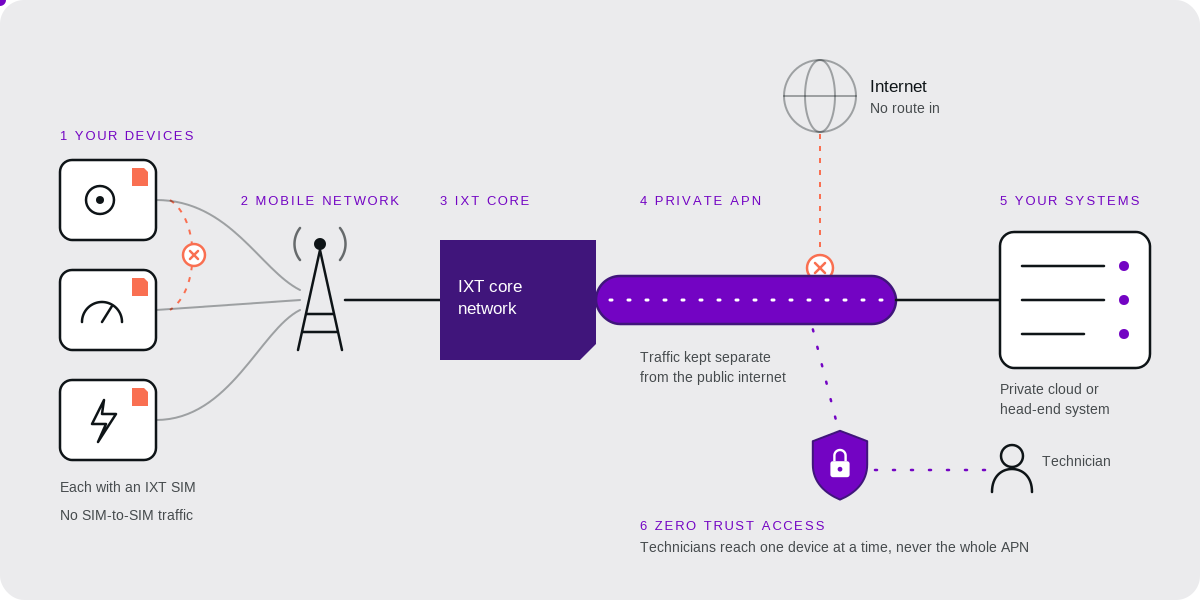
When a device attaches to the mobile network, the SIM authenticates and the device requests the APN set in its network settings. The operator's core network checks that the SIM belongs to that APN and assigns an IP address from your private range, static or dynamic. Traffic then runs from the operator's packet gateway to your systems over an IPSec VPN tunnel, a private IP-VPN or a direct cloud connection.
In 5G networks the same concept is called a DNN (Data Network Name). Private APN and private DNN do the same job.
Private APN vs public APN
A public APN gives your device internet access. Some operators, IXT included, put devices on that APN behind a CG-NAT firewall with non-routable addresses, which drops unsolicited inbound connections. That helps. It is not isolation.
As Henning Solberg explains: “Most operators these days provide some kind of protection in terms of network address translation… That prevents some of the traffic that comes from the internet towards the device. But obviously there is session hijacking, there is UDP, for example, and there are other ways to manipulate those connections coming from a regular SIM.”
The worst case is a SIM on an internet APN with a public IP address, plus a device still on its factory password. Public IP addresses are what left supermarket freezer controllers open to attack across Europe in autumn 2026. Read how the freezer attacks happened.
A private APN takes the internet out of the path. Your device reaches your backend and nothing else.
What a private APN does not solve
A private APN keeps outsiders out. It does not show you what happens inside. Devices on the APN still make connections nobody planned. Henning has described an EV charger, set up to reach one backend, with a cellular module that kept trying to connect to a manufacturer's firmware server in South Korea. Nobody had configured that connection, and nobody saw it until traffic visibility was switched on.
Third-party access is the other gap. When a vendor needs to troubleshoot a device, the old answer was a VPN client into the APN. Henning explains the problem: “That creates a tunnel from your device into the private APN, and then you get access to all the devices within that APN. Obviously that creates a loophole with the VPN.”
This is why IXT pairs private networking with Zero Trust. Zscaler ZTNA gives technicians clientless browser access to one device at a time, with every session recorded. The Illumio traffic map shows every connection your devices make and flags behaviour that steps outside the baseline. IXT also blocks SIM-to-SIM traffic in its packet gateways, so one device on the APN has no route to another.
When do you need a private APN?
Use a private APN when your devices talk only to known backend systems, when the traffic carries operational commands, payments or personal data, or when NIS2 applies to you and you need to show network segmentation. EV charging, utilities, water treatment, alarm systems and industrial automation match all three.
A public APN still fits devices that need to reach many internet services, such as consumer products calling third-party APIs. Even then, keep them behind CG-NAT and never on a public IP address with default credentials.
Private APN with IXT
IXT is a full MVNO and runs private APNs in its own core network through IXT SecureNet. You get static or dynamic private IP addresses, two IPSec VPN tunnels, IXT-managed DNS and NTP, and direct connections to AWS, Azure, GCP and Alibaba Cloud. The same IXT Global SIM works across 600+ networks in 190+ countries, so your private APN goes wherever your devices go.
You manage the SIMs on the APN in the IXT CMP, and SecureNet is built to run with IXT Zero Trust from day one.