IXT Global SIM
for Secure M2M IoT Connectivity
Deploying connected devices across borders means managing different carriers, roaming rules, and data laws in every market. Each new country adds a contract, a point of failure, and a security gap.
The IXT Global SIM removes that fragmentation. One SIM connects your M2M and IoT devices across 600+ mobile networks in 190+ countries, with private networking and Zero Trust security built on infrastructure IXT owns and operates.
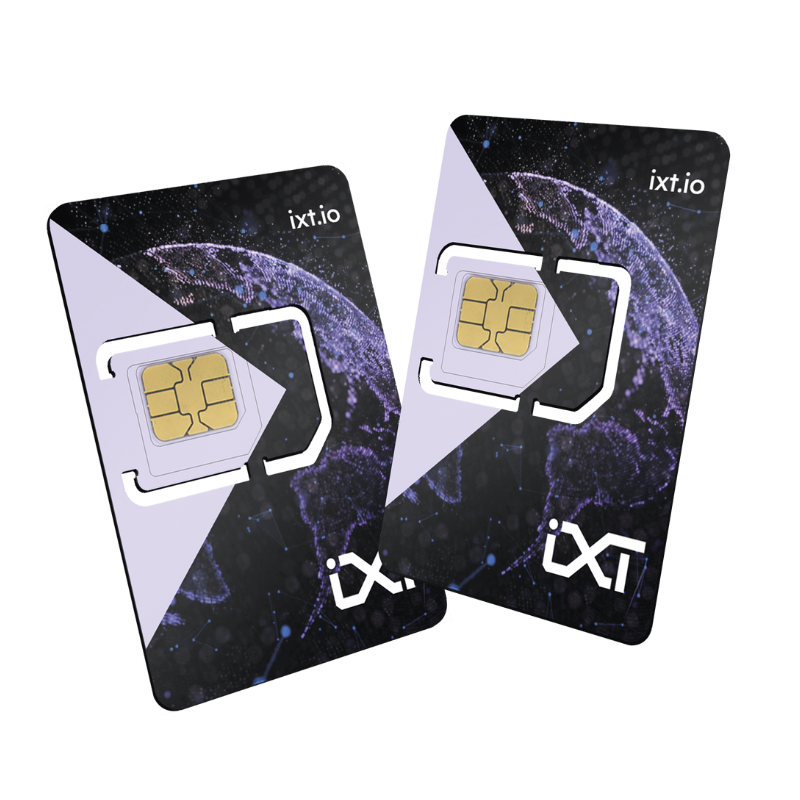
The IXT Global SIM is a global IoT SIM card for machine-to-machine (M2M) and embedded device connectivity. It uses multi-IMSI technology and eUICC (eSIM) remote provisioning to connect devices across 600+ mobile networks in 190+ countries, automatically selecting the strongest available signal. It supports 2G, 3G, 4G, 5G, LTE-M, and NB-IoT, and ships in 2FF, 3FF, 4FF, and MFF2 (embedded eSIM) form factors, with iSIM compatibility.
IXT is a full mobile virtual network operator (MVNO) that owns its core network, so authentication, routing, and security are enforced at the infrastructure level. Security options include a private APN, VPN, static IP, and IXT Zero Trust, the standard security model for regulated and cross-border deployments. Every SIM is managed in real time through the IXT Connectivity Management Platform (CMP).
What is an IoT SIM card and how does it work?
An IoT SIM card is a cellular SIM built for machines instead of phones. It gives a connected device, such as a tracker, smart meter, EV charger, router, or industrial sensor, an identity on a mobile network to send and receive data without a person involved. This is the basis of M2M communication.
An IoT SIM works in five steps:
The SIM is installed in the device as a removable card, an embedded chip (MFF2 eSIM), or an integrated SIM (iSIM) built into the device processor.
The device powers on and its cellular modem scans for available networks across 2G, 3G, 4G, 5G, LTE-M, or NB-IoT.
The SIM authenticates the device. It stores a unique IMSI (International Mobile Subscriber Identity) and a secret key, and the network verifies these before granting access.
The network assigns connectivity and routes traffic through an APN (Access Point Name). A private APN keeps that traffic off the public internet.
The device exchanges data with an application or cloud platform, sending telemetry and receiving commands.
An IoT SIM differs from a phone SIM in four ways that matter for device fleets. It supports multi-network roaming so a device connects to more than one carrier per country. It supports remote management, so you activate, suspend, or reprovision SIMs from a central platform. It supports eUICC remote provisioning, so you change operator profiles over the air without touching the hardware. And it is sized for M2M traffic patterns, from low-power sensors to high-bandwidth video.
What is the difference between an IoT SIM, an M2M SIM, and an eSIM?
An M2M SIM and an IoT SIM describe the same thing: a SIM for autonomous machine communication. "M2M" is the older term for direct device-to-device data, and "IoT" is the broader term covering fleets of connected devices reporting to cloud platforms. An eSIM (embedded SIM, MFF2 form factor) is a physical format, a chip soldered onto the device board. It is not a different type of connectivity. Most IoT and M2M SIMs, including the IXT Global SIM, are available as both removable cards and embedded eSIMs, and support eUICC for remote profile switching.
How does IXT secure M2M and IoT connectivity across countries?
Securing IoT connectivity across borders means treating every network, in every country, as untrusted. The IXT Global SIM builds that principle into the connectivity layer across four areas.
Device identity and the SIM as a root of trust
Every IXT SIM authenticates on the network using its IMSI and cryptographic keys before any data moves. Because IXT owns the core network, authentication is enforced at the infrastructure level rather than resold from a host operator. IMEI locking ties a SIM to a specific device, so a SIM removed and placed in another device stops working.
Private networking that keeps traffic off the public internet
IXT SecureNet routes device traffic through a private APN, VPN tunnels, and static or private IP addresses, direct to your data centre or cloud on AWS, Azure, Google Cloud, or Alibaba Cloud. Devices are invisible to the public internet, which removes the exposure to scanning, brute-force attempts, and inbound attacks that comes with open cellular access.
Zero Trust security for headless devices
IXT Zero Trust is the standard security model for regulated and cross-border deployments. It extends Zscaler ZTNA and Illumio traffic visualisation to IoT and OT devices over cellular, without agent software on the device. All traffic is device-initiated, so no ports are exposed. Traffic is mapped in real time, anomalies are flagged automatically, and segmentation contains a compromised device before it reaches the rest of the fleet. Service technicians and third-party vendors get clientless, time-limited, recorded remote access to a device, without a VPN into the wider network. This supports the controls that regulations such as NIS2 require: segmentation, supplier access management, and audit trails.
Cross-border compliance and permanent roaming
Several countries restrict permanent roaming, where a foreign SIM stays on a local network beyond a set period. Data sovereignty rules such as GDPR in the EU also govern where data is processed and stored. The IXT Global SIM uses eUICC remote provisioning to apply a local operator profile over the air where roaming is restricted, so devices stay connected and compliant without a truck roll. Multi-network access in each country means that if one network drops, the device moves to the next automatically.
Real-time visibility across the fleet
Every SIM reports into the IXT CMP in real time. You see connectivity status, data usage, location, and session diagnostics as they happen, not on a 24 to 48 hour delay. You suspend a SIM, set usage alerts, search by ICCID, and act on anomalies immediately. Real-time control is the difference between spotting an unusual data spike as it starts and finding it a day later.
Key features
Global multi-network connectivity
Access to 600+ networks across 190+ countries, with automatic switching to the strongest signal. No separate contract per country.
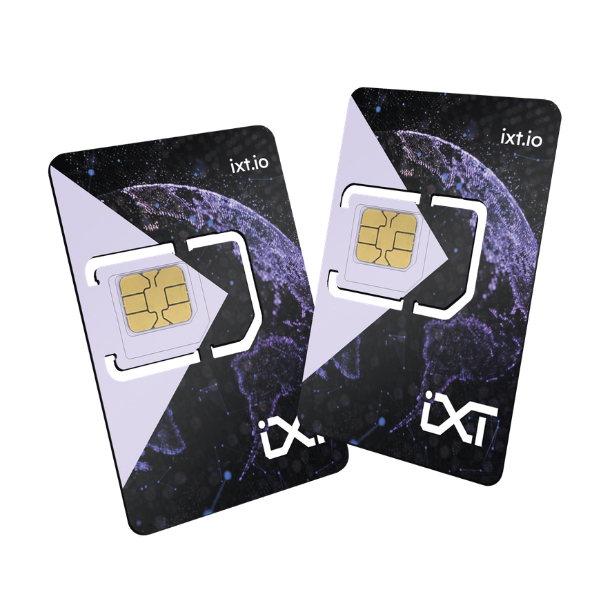
Every form factor.
2FF, 3FF, 4FF, MFF2 embedded eSIM, and iSIM compatible. One SIM identity across every device type.

eUICC remote provisioning.
Add, switch, or retire operator profiles over the air. Local profiles solve permanent roaming restrictions without physical access.

Full network technology support
2G, 3G, 4G, 5G-NSA, 5G-SA, LTE-M, NB-IoT, and NTN. High bandwidth or low-power, the same SIM adapts per use case.

Security built in.
Private APN, VPN, and static IP as standard, with IXT Zero Trust for regulated and cross-border deployments.

Built on IXT's own core.
A full MVNO with its own greenfield IoT core network. Direct troubleshooting, no third-party carrier dependency.

Real-time control through IXT CMP.
Live connectivity, usage, and cost data. Manage thousands of SIMs from one dashboard.
Shared data across the fleet.
The IXT Global Data Pool lets all SIMs draw from one pool, so no device runs out while others sit idle, and there are no per-SIM overage fees.
IXT Global SIM compared to a standard MNO or MVNO SIM
| Capability | Typical MNO or reseller SIM | IXT Global SIM |
|---|---|---|
| Network control | Resold from a host operator | Full MVNO, IXT owns the core network |
| Coverage | Home network plus roaming agreements | 600+ networks, 190+ countries, multi-network per country |
| Fleet visibility | Portal with 24 to 48 hour data delay | Real-time data through IXT CMP |
| Private networking | Often unavailable or extra | Private APN, VPN, static IP through SecureNet |
| Security model | VPN at best | Zero Trust, no exposed ports, traffic mapping, clientless remote access |
| Permanent roaming | Risk of local blocking | Local profiles applied over the air via eUICC |
| Support | Tiered through the host carrier | Direct from an IoT-focused MVNO |
Who is IXT Global IoT SIM for?
The IXT Global SIM is built for organisations deploying connected devices across regions that need coverage, security, and central control without carrier fragmentation. Common deployments include:

Fleet and asset tracking
Keep vehicles and cargo connected across borders without roaming gaps.
Industry & manufacturing
Connect and manage factory sensors and equipment globally with guaranteed uptime and automatic failover.
Utilities and smart metering
Continuous, secure connectivity for large meter fleets with predictable data costs.

EV charging
Reliable connectivity for payment processing, remote diagnostics, and load balancing, including sites with no fixed line.

Security and surveillance
Keep cameras and access control online, and stop the security system becoming the attack surface.

Healthcare and connected medical devices
Secure transmission of device data across markets with private networking.
Frequently asked
questions
The IXT Global SIM is a global IoT and M2M SIM card that connects devices across 600+ mobile networks in 190+ countries from one SIM identity. It supports removable, embedded eSIM (MFF2), and iSIM form factors, uses eUICC for remote provisioning, and includes private networking and Zero Trust security options managed through the IXT CMP.
Yes. One IXT Global SIM connects across 600+ networks in 190+ countries and switches to the strongest available network automatically. Where a country restricts permanent roaming, IXT applies a local operator profile over the air through eUICC, so the device stays connected without a site visit.
The SIM supports 2G, 3G, 4G, 5G-NSA, 5G-SA, LTE-M, NB-IoT, and NTN, with multi-network access in each country. It selects the best available signal for each device and use case.
Yes. The IXT Global SIM ships in 2FF, 3FF, 4FF, and MFF2 embedded eSIM form factors, and is iSIM compatible. eUICC lets you switch operator profiles remotely, so you change networks without replacing hardware.
Security is enforced on IXT's own core network. Options include a private APN, VPN, and static IP through SecureNet, and IXT Zero Trust, which extends Zscaler ZTNA and Illumio visualisation to devices with no exposed ports and no agent software. Traffic is mapped in real time and segmented to contain any compromised device.
IXT uses eUICC local profiles to meet permanent roaming rules and gives real-time visibility over where devices connect and how much data they use. Zero Trust segmentation and audit trails support the controls required by regulations such as NIS2. IXT supports these controls. Each customer owns its own compliance posture.
Every SIM is managed in the IXT CMP. You activate, suspend, and group SIMs, search by ICCID, set usage alerts, and view live connectivity and diagnostics. Data is real time, not delayed 24 to 48 hours as with many provider portals. An API lets you pull SIM data into your own systems.
Request a test SIM to trial coverage and control in your own deployment, or talk to an IXT expert to scope a fleet across your markets.
Talk to a IoT connectivity expert about your global deployment.
Key IoT connectivity terms
IMSI (International Mobile Subscriber Identity): the unique identity a SIM presents to a mobile network to authenticate a device.
ICCID: the serial number that identifies the physical SIM, used to search and manage a SIM in the IXT CMP.
APN (Access Point Name): the gateway that connects a device to a data network. A private APN routes traffic off the public internet.
eUICC: the technology that lets a SIM hold and switch operator profiles remotely, over the air.
eSIM (MFF2): an embedded SIM soldered onto the device board. Resistant to theft, vibration, and moisture.
iSIM: an integrated SIM built into the device processor (system-on-chip), saving space and power.
Multi-IMSI: a SIM that carries several network identities to switch to a local profile across countries.
LTE-M and NB-IoT: low-power cellular standards built for IoT. NB-IoT suits stationary, deep-indoor, low-data devices. LTE-M suits moving devices that need better latency.
Permanent roaming: when a foreign SIM stays on a local network beyond an allowed period. Some countries restrict it, which eUICC local profiles resolve.
MVNO: a mobile virtual network operator. IXT is a full MVNO that owns and operates its own IoT core network.
CMP (Connectivity Management Platform): the platform for activating, monitoring, and controlling a SIM fleet in real time.