eSIM for IoT: Answers to the Questions That Matter
One pool. All your SIMs. Around the world.
Choosing the right SIM technology shapes how your devices connect, scale, and stay secure, here are the answers IoT teams ask before they commit to one.
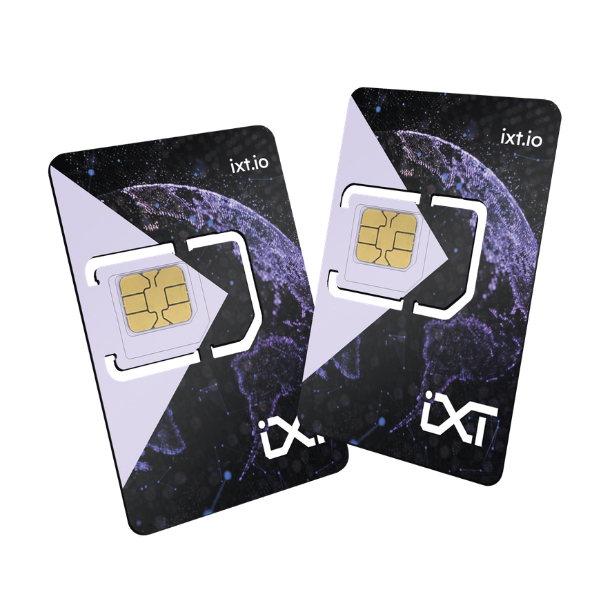
An eSIM (embedded SIM) is a programmable SIM built into a device rather than inserted as a removable card. It stores one or more carrier profiles and supports remote provisioning, so a device connects to a network without a physical SIM swap. For IoT deployments, eSIM enables devices to launch with one hardware configuration and activate connectivity in any market, switch network profiles remotely, and stay connected across borders without a technician visiting each unit.
IXT provides eSIM as part of its Global SIM, built on multi-IMSI technology, with access to 600+ mobile networks in 190+ countries and eUICC support for remote profile management.
eSIM Basics
An eSIM is a SIM built directly into a device, rather than a removable card. It performs the same function as a physical SIM, connecting a device to a mobile network, but the profile that identifies the device to a carrier is loaded and managed digitally instead of through a swappable chip.
A physical SIM (2FF, 3FF, 4FF) is a removable chip that a technician inserts into a device and physically swaps to change carriers. An eSIM is soldered onto the device board (MFF2 form factor) and holds its network profile in software. Carrier profiles on an eSIM are loaded, updated, or switched remotely, without opening the device.
An eSIM is a separate physical chip embedded in the device. An iSIM (integrated SIM) goes a step further and builds the SIM function directly into the device's main processor, removing the need for a separate SIM chip entirely. iSIM reduces board space and power draw, which matters for small or battery-constrained IoT hardware. IXT SIMs are iSIM-compatible alongside standard eSIM support.
No. An eSIM is fixed to the device it is soldered into. What moves is the network profile inside it, not the eSIM hardware itself. A single eSIM can hold or switch between multiple carrier profiles without any physical change to the device.
An eSIM needs an initial data or network connection to download its first carrier profile, typically provided by the eSIM manufacturer or a bootstrap profile. After that, profile updates and switches happen over the existing cellular connection, so no separate internet or Wi-Fi setup is required for IoT deployments.
eUICC (embedded Universal Integrated Circuit Card) is the technology standard that makes eSIM programmable. It is the operating environment inside the eSIM chip that allows multiple carrier profiles to be stored, added, deleted, or switched remotely. When a SIM is described as "eUICC compliant," it means the chip supports over-the-air profile management under GSMA specifications.
eSIM for IoT
IoT devices are often deployed in remote, hard-to-reach, or high-volume locations, from shipping containers to utility meters to industrial sensors. A physical SIM requires someone to open the device and swap the card to change carrier or fix a connectivity issue. An eSIM removes that step. Profiles are managed remotely, devices are sealed at manufacture, and connectivity issues are resolved without a site visit.
The IoT-specific eSIM form factor is MFF2, a compact, solder-mounted chip designed for embedded use rather than a removable slot. IXT supports MFF2 alongside 2FF, 3FF, 4FF, and iSIM-compatible formats, so the same SIM technology fits everything from handheld devices to fixed industrial hardware.
Yes. This is the core function of eUICC. Over-the-air (OTA) profile updates let an operator add a new carrier profile, switch the active network, or update settings on a deployed device without a technician present. For fleets spread across multiple countries, this removes one of the largest operational costs in IoT connectivity management.
Remote SIM provisioning is the GSMA-defined process for downloading, installing, enabling, and deleting SIM profiles on an eUICC over the air. For IoT, RSP means a device can be manufactured, shipped, and deployed globally with generic connectivity, then activated with the correct local or roaming profile after installation, without physical intervention.
Yes. eSIM and eUICC operate independently of the device's user interface. Headless devices, sensors with no display, and constrained hardware with limited processing power all support eSIM connectivity and remote profile management in the same way as more capable devices.
SGP.32 is the GSMA specification for IoT-optimized remote SIM provisioning, built to simplify profile management for devices without a user interface. It is designed to reduce the complexity of earlier RSP standards for large-scale, unattended IoT deployments. IXT tracks GSMA specification updates, including SGP.32, as part of its eSIM roadmap.
Coverage and Connectivity
Coverage depends on the carrier agreements behind the eSIM, not the eSIM technology itself. An eSIM loaded with a single carrier profile is limited to that carrier's coverage and roaming agreements. IXT's Global SIM uses multi-IMSI technology to access 600+ mobile networks across 190+ countries, so coverage extends well beyond what a single-carrier SIM offers.
A well-provisioned IoT eSIM does not depend on a single network. With multi-IMSI or multi-network technology, the SIM evaluates available networks and connects to the strongest signal, switching automatically if one network becomes unavailable. This reduces the downtime risk that comes with single-carrier SIMs.
Yes, if the eSIM uses multi-IMSI technology. Multi-IMSI means the SIM holds several carrier identities and selects the best available network in a given location, rather than being locked to one carrier. This is standard on IXT's Global SIM and is a major reason it performs well for cross-border and remote deployments.
IMSI (International Mobile Subscriber Identity) is the unique identifier that ties a SIM to a specific carrier. A multi-IMSI SIM stores several of these identities and switches between them based on signal strength and network availability. This gives IoT devices network redundancy, so a local outage on one carrier does not take the device offline.
Yes. Network technology and SIM form factor are independent of each other. An eSIM supports whatever radio technologies the device and network allow, including 2G, 3G, 4G, 5G-NSA, 5G-SA, NB-IoT, and LTE-M. IXT's Global SIM supports this full range across its network footprint.
Security and Compliance
An eSIM is harder to physically remove or tamper with, since it is soldered to the device rather than accessible through a card slot. This reduces one category of risk, physical SIM theft or swap fraud. It does not, on its own, secure the data traffic the device sends and receives. That requires network-level security such as private APN, VPN, or Zero Trust architecture on top of the connectivity layer.
Yes. Because eSIM profiles are managed through a connectivity management platform, an operator can suspend, deactivate, or reconfigure a SIM remotely the moment a device shows signs of compromise or is reported lost. IXT's CMP supports this kind of quick action across a fleet, searchable by ICCID.
No. eSIM addresses provisioning and device identity management. NIS2 requires broader controls, including access management, network segmentation, incident detection, and supply chain risk management. eSIM is one building block. Meeting NIS2 obligations for connected devices typically requires private networking and Zero Trust controls layered on top of the SIM itself.
eSIM secures how a profile is provisioned and managed. It does not, by itself, control what happens to the data traffic once a device is connected. Devices are still exposed if traffic runs over the public internet, if third-party vendors have broad remote access, or if there is no visibility into unusual device behavior. These risks are addressed at the network and application layer, through private APN, VPN, or Zero Trust architecture.
Deployment and Management
There is no practical limit tied to the eSIM technology itself. A connectivity management platform is built to filter, sort, label, and manage fleets ranging from a handful of devices to hundreds of thousands. IXT's CMP is designed for exactly this, giving fleet-wide visibility alongside individual SIM detail.
Yes, when the connectivity provider supports it. Rather than each device carrying its own fixed data allowance, a shared data pool lets an entire fleet draw from one allocation. This avoids stranded data on underused devices and unexpected overage charges on high-use ones.IXT's Global Data Pool works this way across all SIMs on an account.
With a single-carrier physical SIM, expanding into a new country often means sourcing a new SIM and repeating a hardware rollout. With a multi-network eSIM, expansion is a matter of the device connecting to available local networks under existing roaming and multi-IMSI agreements, without a new SIM or a site visit.
Activation at scale depends on the SIM being provisioned and ready before deployment, not after. IXT ships SIMs pre-activated and ready to connect, and coverage is only billed once a device is actually online, so devices sitting in warehouse inventory are not incurring costs before deployment.
Yes, with the right platform. Many connectivity providers report device status with a 24 to 48 hour delay, which makes troubleshooting slow. IXT's CMP is built on a full MVNO core network, giving direct, near real-time visibility into connectivity status, location, and data usage, without the lag typical of reseller platforms.
IXT eSIM
IXT SIMs are pre-activated and ready to connect, but billing starts on first use, not at the point of purchase. This means SIMs can sit in inventory or be shipped with hardware without incurring costs before a device actually goes live.
Yes. IXT SIMs support pause and unpause flexibility, so a device that is temporarily offline, in storage, or between deployments does not need to be billed continuously or replaced.
IXT's Global SIM uses multi-IMSI technology to reach 600+ mobile networks across 190+ countries, with support for 2G, 3G, 4G, 5G-NSA, 5G-SA, NB-IoT, and LTE-M.
Yes. IXT's eSIM and physical SIM options connect to the same core network, so SecureNet private networking and Zero Trust security, powered by Zscaler ZTNA and Illumio, apply the same way regardless of SIM form factor.